


Most visitors spot it on their first day. Those big Arabic letters carved into the hillside above Agadir — visible from the beach, from the road, sometimes from the plane coming in. And almost everyone ends up Googling the same thing: what does that actually say? Short answer: God, Homeland, King. But there's more to it than a translation — the words have a legal status, a history tied to one of Morocco's worst disasters, and a meaning that still matters to people here today.
The Words on Agadir Mountain: "الله، الوطن، الملك"
Three words. Allah, Al-Watan, Al-Malik — God, Homeland, King. Morocco's national motto, cut into the rock of Oufella Hill above the city, facing the Atlantic. On a clear day you can read it from the beach without binoculars.
What Each Word Means
Morocco is a Muslim country, and that's not just a demographic fact — it shows up in the calendar, the call to prayer, the way people greet each other. The first word of the motto puts that front and center.
Not just territory. The word carries a sense of belonging — to the land, the culture, the people. In a country as geographically and ethnically diverse as Morocco, that idea does a lot of work.
The King is head of state and Commander of the Faithful. It's a dual role — political and religious at once. The monarchy here isn't just ceremonial; it's woven into how the country functions.
Not Just a Slogan — It's Written Into Moroccan Law
A lot of visitors assume the inscription is decorative. Put there to look impressive, maybe to welcome tourists. It's actually the opposite of that. Article 4 of the Moroccan Constitution is about as official as it gets:
"The motto of the Kingdom is: God, Homeland, King."
Same words you see on Oufella Hill. Same words on government letterheads, official institutions, state ceremonies, and school buildings across the country. The inscription isn't art — it's a constitutional declaration, painted on a mountain so everyone can see it.
"شعار المملكة هو: الله، الوطن، الملك."
هذا الشعار يُعبّر عن:
الله: ارتباط الدولة بالدين الإسلامي
الوطن: وحدة التراب الوطني والانتماء
الملك: النظام الملكي ودور الملك كرمز للأمة
الشعار رسمي ومُثبت دستورياً، ويُستعمل في الوثائق الرسمية، المؤسسات، والخطاب الوطني.
Locals don't treat the inscription as a tourist feature. It's not sacred the way a mosque is sacred, but it's not background scenery either. When you stand in front of it — especially if you go up the hill and get close — you realize it was put there with intention, and it's stayed there for a reason.
The 1960 Earthquake and Why This Hill Matters
The inscription went up in the 1970s, but to understand why, you need to go back to 1960. On February 29th of that year, an earthquake hit Agadir at around midnight. It lasted less than 15 seconds. Over 15,000 people died — roughly a third of the city's population at the time. Most of the buildings simply collapsed.
The city that stands today was built almost entirely from scratch after that. New grid, new buildings, new seafront. And as Agadir rebuilt through the 1960s and 70s, the inscription went up on Oufella Hill — the same hill where the Agadir Oufella Kasbah still stands. The kasbah is a 16th-century fortress, older than the earthquake, and what's left of it sits right above the city with views you won't find anywhere else in Agadir.
Want to See It Up Close?
Standing on the beach squinting at the hillside is one way to do it. Going up with a local guide who actually knows the history — the earthquake, the kasbah, the story behind each trail — is a different experience entirely.
🥾 Book a Guided Hike From AgadirGoing Up There — What to Expect
Where to Photograph It
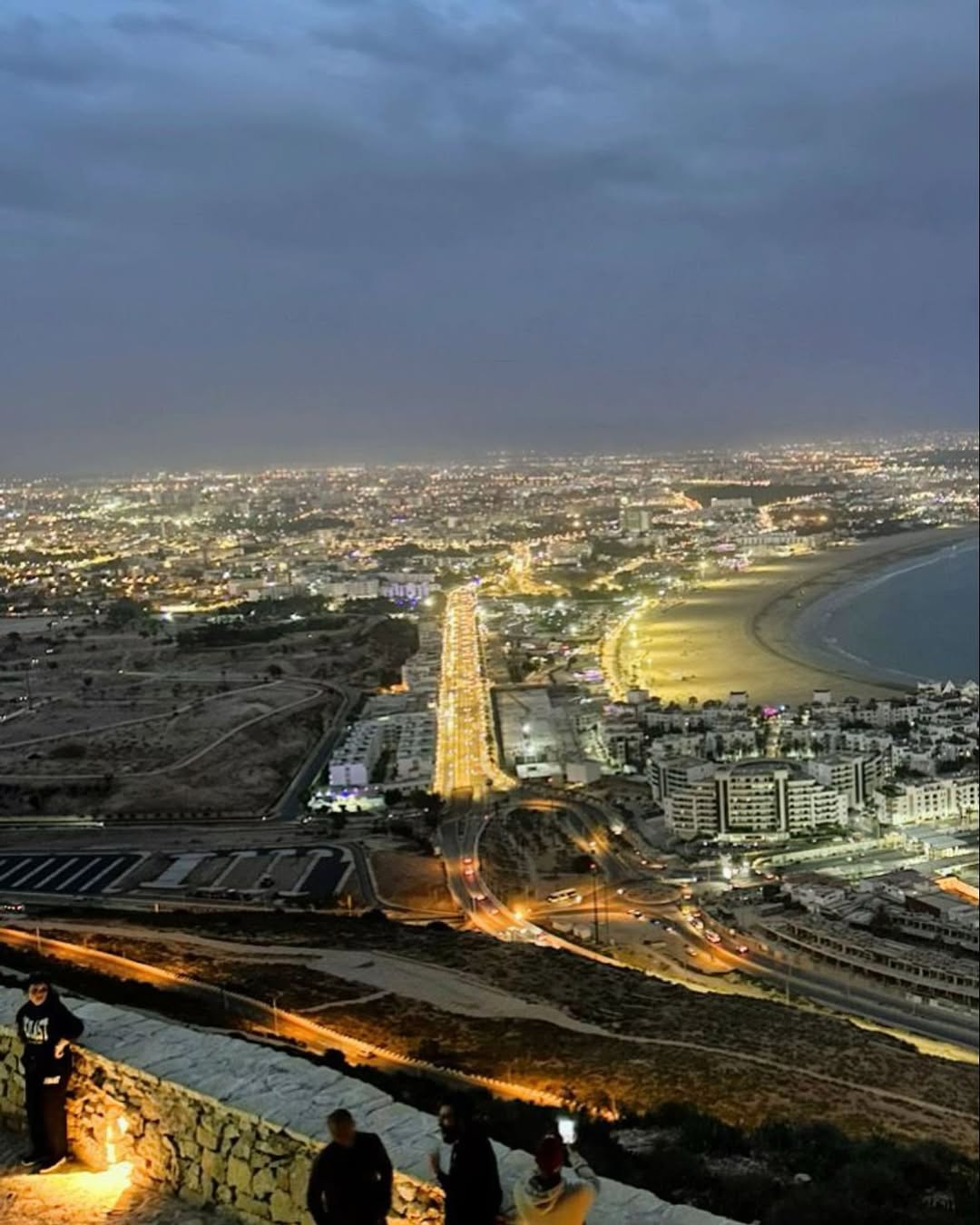
The beachfront promenade gives you the cleanest shot — full inscription, full hill, open sky. Go at dusk when the letters are lit and the light is warm. If you want to get physically close, take a taxi or walk up to Oufella. The path is rough in spots but not hard. The view from the top over the bay is the real payoff — most people are surprised by how much you can see up there.
The Kasbah is now a managed heritage site. It has an entrance fee, official opening hours, and on-site services. Here's what the official site says:
Opening Hours
The Kasbah is open every day of the year. Last entry is 30 minutes before closing.
Entrance Tickets
There are different ticket types depending on group size and extras. Moroccan residents and international visitors have separate pricing. Online booking is available at tickets.agadir-oufella.ma.
Getting There
Five ways to reach the Kasbah — depending on how much effort you want to put in before you even arrive.
What's Available On-Site
The site has more than most people expect. A team of reception staff is there to orient you when you arrive.
What to See Inside
The Kasbah isn't just ruins and views. The official site lists several categories of things to explore on-site:
Full details, opening hours, and ticket booking at the official site: agadir-oufella.ma/en/useful-information
A Note on Respect
The letters aren't a climbing frame. They're not sacred exactly, but they mean something — constitutionally and to the people who live here. Don't touch them, don't pose on them. Take your photo from a distance and that's enough.
Frequently Asked Questions
There's More Out Here Than the Mountain
Agadir is a good base. Paradise Valley is 40 minutes away, the hidden canyons between Taghazout and Tamraght are almost unknown to tourists, and there's a long list of other things to do in Agadir beyond the mountain. If you want to get off the beach and actually see the region, a half-day hike is the best use of your time here.
🥾 Book Your Guided Hike Today